1
Warm-up beliefs
8 min · Individual → class
Students tick the seven statements they believe are generally true, then compare positions. Invite brief debate on busyness, control, compounding and giving time away.
Teacher note: Use controversial statements A and F to activate the topic without confirming answers yet.
2
Personal time reflection
7 min · Individual → pairs
Students complete the four personal sentence frames about screen time, free time, routines and moments when time felt slow. Partners identify one shared pattern.
Teacher note: Focus feedback on the contrast between routine and brand-new experience.
3
Vocabulary and core principles
10 min · Individual → pairs
Students complete the four gap sentences, compare and explain each contrast in their own words.
Teacher note: Answers: busy/productive; overestimate/underestimate; waste/investment; routines/compound.
4
Choose and justify
8 min · Pairs
Pairs choose between the six productivity and lifestyle options, using at least one target word in every explanation.
Teacher note: Do not impose one correct lifestyle choice; assess the quality of justification.
5
Discussion and mindfulness
8 min · Groups
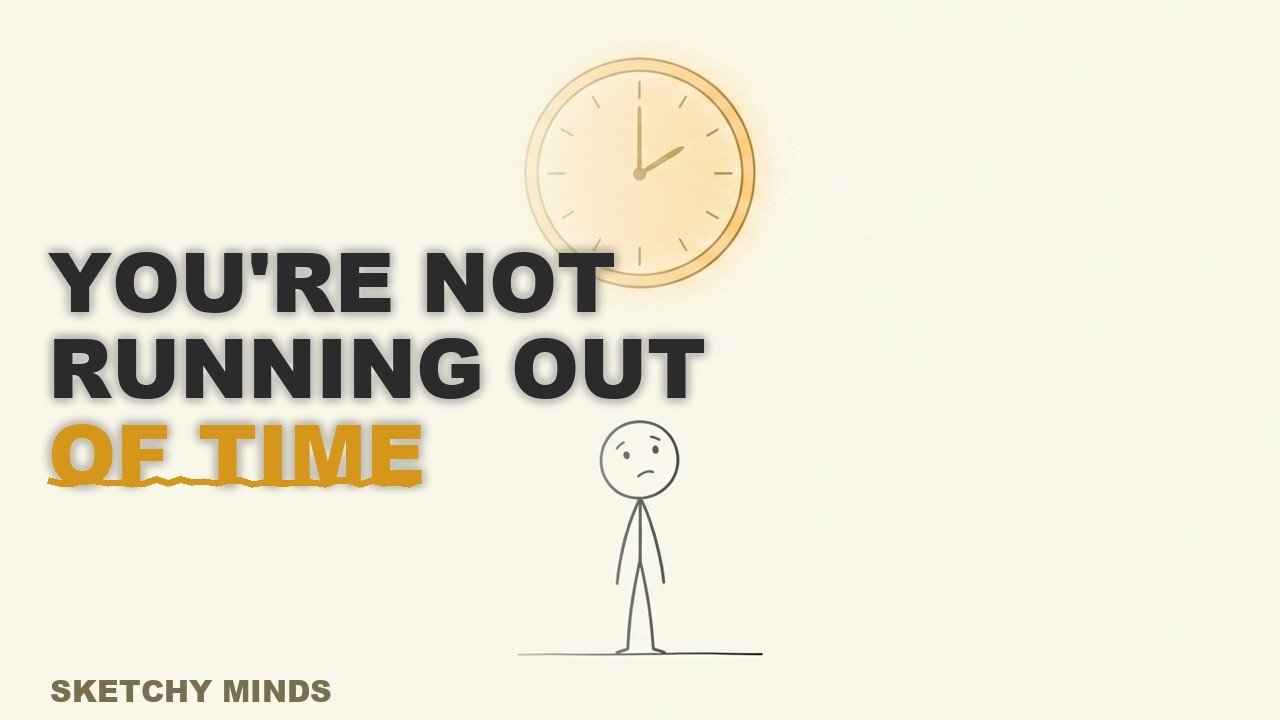
Groups discuss running out of time, energy vampires, novelty, analog hours and autopilot. Use the illustration to elicit what “expanding time” might look like.
Teacher note: Keep this stage brisk: assign different questions to groups, then rotate one speaker.
6
Match and take a position
9 min · Pairs → class
Students match the five sentence halves, check answers, then choose which completed claims they agree with and explain why.
Teacher note: Answer key: A–4, B–3, C–2, D–5, E–1. Probe the control paradox and energy management.
7
Video prediction
5 min · Individual → pairs
Play to 00:33. Students select the likely focus of part two and justify their prediction from the opening.
Teacher note: Correct answer: cognitive biases that make us feel rushed and ways to slow life down.
8
Video case study: true or false
12 min · Individual → pairs
Play from 00:34. Students decide whether six statements are true or false and correct every false statement. Replay selected lines for evidence.
Teacher note: Answers: T, F, T, F, T, F. Highlight the time unit paradox, 80/20 rule, effort without attachment, compound effect and deathbed test.
9
Lifestyle audit and commitment
13 min · Groups → individual
Students compare weekly time spent on rigid routines, novel experiences, energy vampires, energy investments and helping others. Each writes one concrete change to test this week.
Teacher note: Finish with a measurable commitment rather than a general intention.